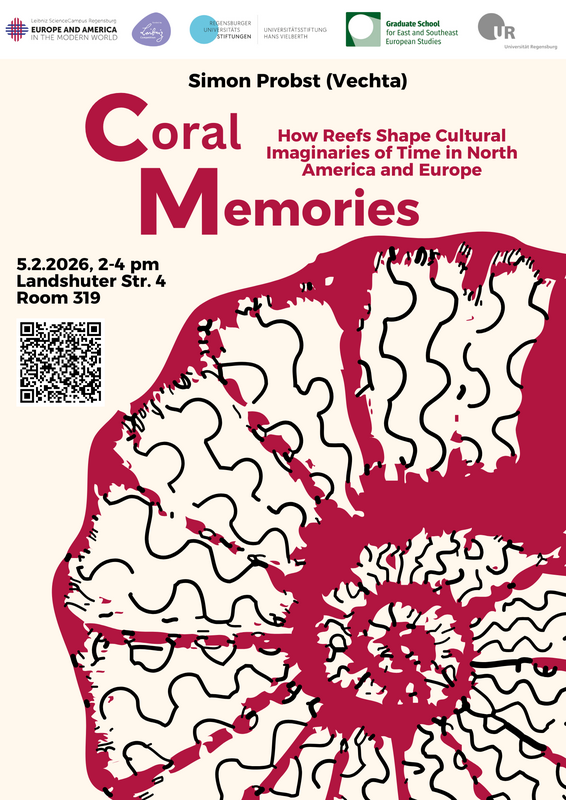
Grad Workshop Keynote | Simon Probst (Vechta) Coral Memories: How Reefs Shape Cultural Imaginaries of Time in North America and Europe
Join us in Room 319 at Altes Finanzamt for the Keynote talk of the 7th annual graduate workshop - this year on Memory Matters
When? 5 Feb, 14:15
No registration required for the keynote
The 7th annual Graduate Workshop’s keynote takes place on Thursday 5th February from 2:15 to 3:45 pm - Simon Probst (Vechta) will discuss Coral Memories: How Reefs Shape Cultural Imaginaries of Time in North America and Europe. Find more details on the main page of the workshop.
Simon Probst is a postdoctoral scholar at Universität Vechta, where he works in the DFG-project “Natural-cultural Memory in the Anthropocene. Archives, Media and Literatures of Earth History” (2024-2026), which addresses cultural dimensions of planetary crises from the perspective of interdisciplinary memory studies. At the intersection of literature and knowledge, his work brings together cultural and literary theory with different fields of scientific knowledge such as climatology, earth system science, or ecosemiotics, developing planetary and ecological perspectives on German literature from the 18th to the 21st century. His 2024 book Sinn in der Klimakrise: Über eine planetare Literaturtheorie (Meaning in the Climate Crisis: On a planetary theory of literature) is available open access from Transcript.
Abstract | This keynote explores how corals shape natural-cultural memories in North America and Europe, foregrounding reefs as oceanic archives of planetary change and agents that shape cultural narratives. It examines how reef-building corals are made readable in the sciences as climate proxies and witnesses of deep time, while also circulating in literature, visual culture, and environmental discourse as metaphors that organize historical accounts, from imperial and national narratives to contemporary imaginaries of ecological crisis. Bringing together blue humanities, memory studies, and the history of science, the talk traces the cultural agency corals perform across laboratories, museums, literature, and artistic practices. Discussing mnemonic agency of corals through the theory of natural-cultural memory, the keynote reflects critically on the extractive, colonial, and epistemic conditions under which corals become natural archives and influence as material witnesses collective narratives of past, present, and future.