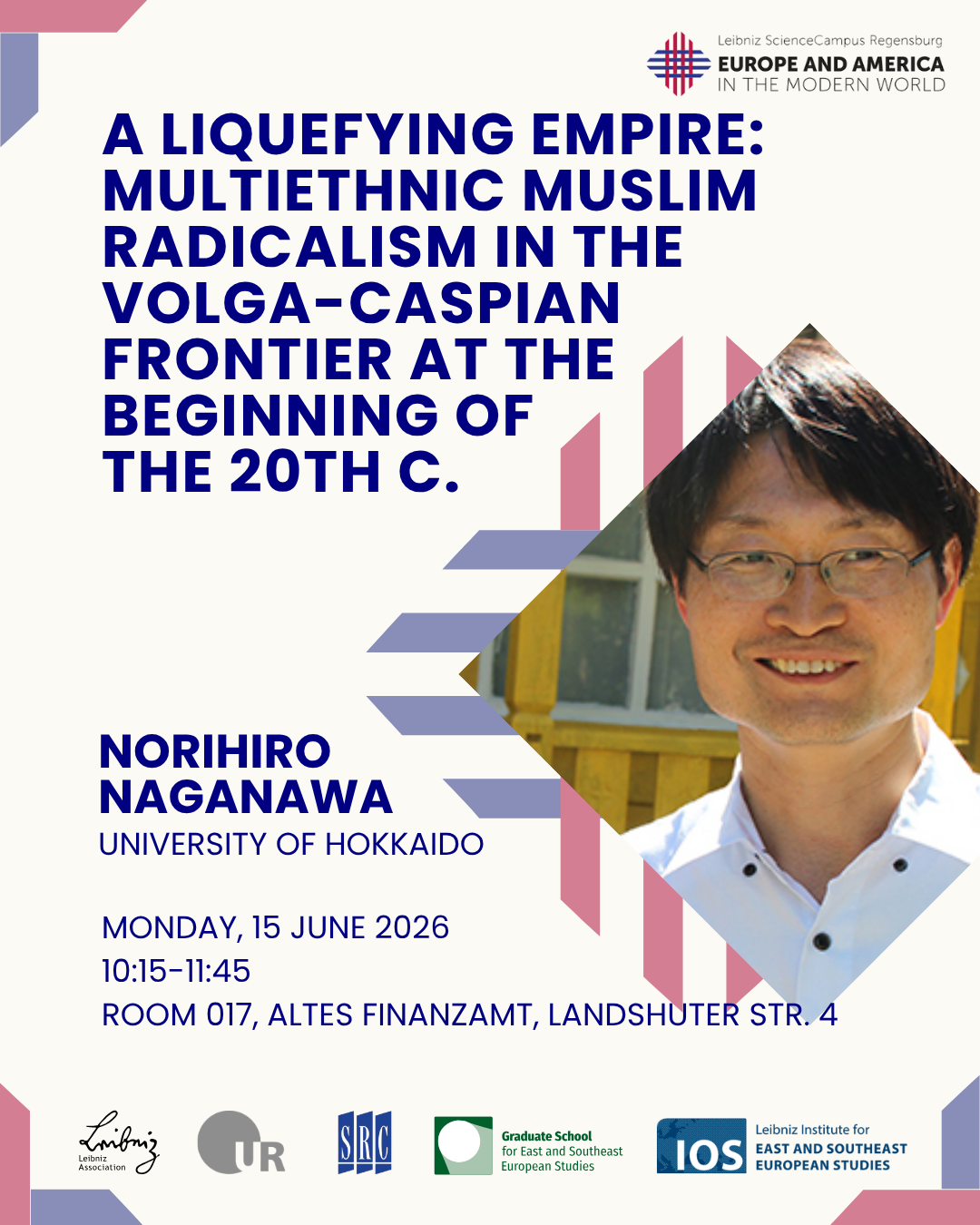
Guest Lecture | Norihiro Naganawa (Sapporo) A Liquefying Empire: Multiethnic Muslim Radicalism in the Volga-Caspian Frontier at the Beginning of the 20th Century
When? Monday, 15 June, 10:15-11:45
Where? Room 017, Landshuter Str. 4, IOS
Join us for a guest lecture with Norihiro Naganawa, who in 2027/28 will be a visiting professor at the ScienceCampus. Learn more about the emerging collaborations with the University of Hokkaido and the Slavic-Eurasian Research Centre there.
Cooperation: Graduate School for East and Southeast European Studies & IOS
Abstract | Port cities along the Volga and the western coast of the Caspian epitomized a function of Russia’s modernizing empire, as they facilitated encounters among its multiethnic subjects. Liliana Riga and Ilya Gerasimov have argued that the Russian language enabled recent migrants to cities to share sociopolitical grievances and to create a distinct plebeian society that cultivated multiethnic collaboration in trade and crime. My presentation considers the role of the Turkic language among the Muslim radical youths in navigating this cosmopolitan terrain. Using Azerbaijani newspapers in Astrakhan and Baku in the era of the Russian, Iranian, and Ottoman revolutions, I explore how these dynamics of collaboration and contention began to undermine imperial rule in this most industrialized corner of the Muslim world. Here, the seismic metaphor of the liquefying ground beneath buildings is apt, as the transnational revolutionary turmoil reinforced horizontal exchanges of global ideas, such as socialism, anarchism, constitutionalism, nationalism, and Islamism, thereby undermining the imperial edifice of vertical contract with multi-confessional subjects. Simultaneously, given the Muslim-Armenian bloodbath in Baku and the rising sectarianism between the Sunni Tatars and the Shiite Azerbaijanis and Iranians in Astrakhan, I also address how cosmopolitanism in the port cities broke down where the mixture was the norm, and how the Muslim radical youths attempted to alleviate tensions after violence.
Bio |Norihiro Naganawa is Professor of Central Eurasian Studies, Hokkaido University. He was the William D. Loughlin member at the Princeton Institute for Advanced Study in 2021 and is a Non-Resident Fellow at the Kennan Institute. Drawing on local knowledge of the Volga-Urals region, his research interests include Muslim communities in the former Russian Empire and the entangled history of Russia and the Middle East. His works have appeared in Slavic Review, Kritika, Ab Imperio, Journal of Central Asian History, and Religion, State & Society. His book, Islamic Russia: Empire, Religion, and Public Sphere, 1905-1917, received the 2019 Mishima Kaiun Memorial Award, given annually for a distinguished contribution to the study of Asian history. He is the editor of Dreams of Emancipation: A Transnational History of Revolutionary Russia (Boston: Academic Studies Press, 2025). Currently, he is writing a biography of Karim Abdraufovich Khakimov (1890-1938), a Tatar revolutionary and Soviet diplomat from Bashkiria, whose trajectory encompasses the Volga-Urals, Turkestan, Bukhara, northern Iran, and the Red Sea. This life story, as a Bolshevik interlocutor with the Muslim world, illuminates the transformation of the fractured empire into an anti-imperialist empire. It also provides Russia’s lessons of engagement with the Muslim world amid global politics.
He has several research projects currently in progress. I am exploring the quest of local Muslims for Islamic knowledge, nationalism, and social reform/revolution in light of global circulation patterns in the 1880s to the 1920s, as well as the Hajj from the late imperial era to Putin’s Russia. He is also endeavoring the writing of the biography of a Tatar revolutionary and Soviet diplomat from Bashkiria, Karim Abdraufovich Khakimov (1890-1938), whose trajectory encompasses the Volga-Urals, Turkestan, Bukhara, northern Iran, and the Red Sea. This life story as a Bolshevik interlocutor to the Muslim world illuminates the transformation of the fractured empire into an anti-imperialist empire. It also provides Russia’s lessons of engagement with the Muslim world amid global politics.