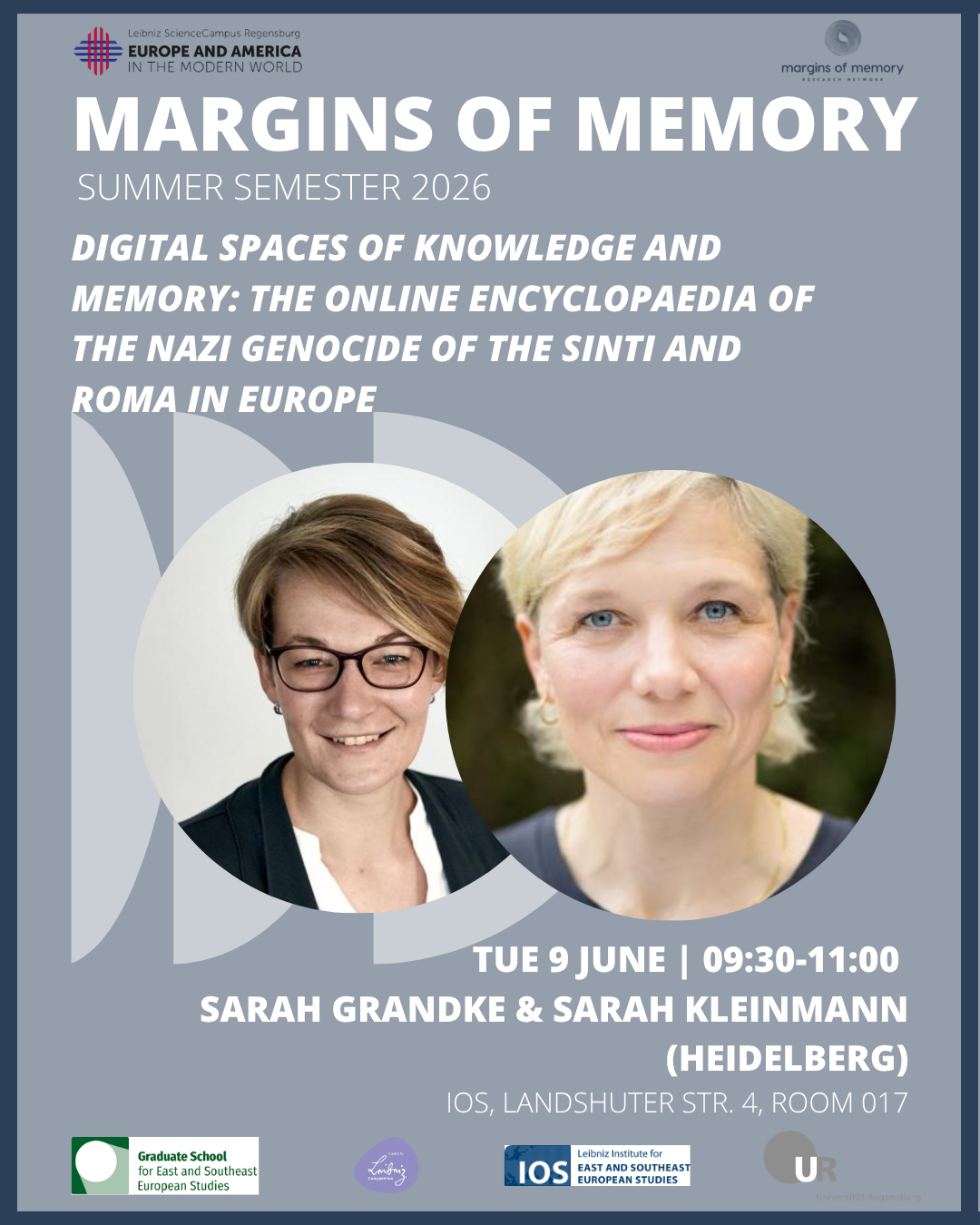
Margins of Memory Talk & Workshop | Sarah Grandke & Sarah Kleinmann (Heidelberg) Digital Spaces of Knowledge and Memory: The Online Encyclopaedia of the Nazi Genocide of the Sinti and Roma in Europe
When? Tuesday, 9 June - public talk 09:30-11:00, followed by a practical workshop session
Where? Room 017 AlFi / IOS, Landshuter Str. 4
Registration: the talk at 09:30 is open to all. Please register for the Workshop part following. Details below
- The talk outlining the work of the digital Encylopaedia of the Nazi Genocide of the Sinti and Roma is open to all. No registration is required for this session. The talk is in English
- The open talk will be followed by a practical session in German discussing the creation, development, management, dissemination and use of the online encylopedia. If you are interested in attending this session from 11:15 to 12:45 please contact campus@europeamerica.de by 3 June 2026. This session is particularly useful for anyone working with the OES software with a view to developing online handbooks, glossaries and encylopedias.
Outline | The presentation will introduce the Encyclopaedia of the Nazi Genocide of the Sinti and Roma in Europe, a work currently being compiled under the direction of Karola Fings at Heidelberg University. This crime against humanity has been insufficiently acknowledged in European societies for decades; in West Germany, the victims were subjected to a second persecution after 1945, and similar patterns of violence and exclusion persisted in other European countries. It was only in 1982, and only after sustained campaigning by the Romani civil‑rights movement, that the Federal Republic of Germany formally recognised that a genocide was carried out against the Sinti and Roma between 1933 and 1945 and that the persecution was racially motivated. To this day many gaps remain in research and public understanding of the persecution and murder of these communities.
The Encyclopaedia seeks to fill those gaps: it serves as a written monument to the victims and survivors, educates the wider public and stimulates further scholarship. The talk will give an overview of the digital content of the Encyclopaedia and will also outline the key ethical and conceptual considerations that have guided the project.
Speakers | Dr. Sarah Kleinmann is a researcher and historian specializing in antisemitism, antigypsyism, memory culture, and National Socialist persecution history. She is currently a Research Associate at the Forschungsstelle Antiziganismus at Heidelberg University, where she works on the project “Encyclopaedia of the Nazi Genocide of the Sinti and Roma in Europe.” Previously, she served as a research associate at the German Institute for Human Rights in Berlin for the Independent Commission on Antigypsyism, and at the Institute for Saxon History and Folklore in Dresden. Earlier in her career, she worked extensively in political education, anti-racism initiatives, and historical memory projects in Germany. Dr. Kleinmann completed her doctorate in Empirical Cultural Studies at the University of Tübingen, where she also studied political science and modern history. Her publications include the monographs Aktueller Antisemitismus in Deutschland: Verflechtungen, Diskurse, Befunde (2021, with Anne Goldenbogen) and Nationalsozialistische Täterinnen und Täter in Ausstellungen (2017), as well as several works on antisemitism-critical education and historical memory culture. In addition to her research, she regularly teaches university courses on antisemitism, Holocaust history, and the persecution of Sinti and Roma in Europe.
Sarah Grandke is a historian, curator, and researcher specializing in the history and aftermath of National Socialism, displacement and migration in postwar Europe, memory politics, and the history of marginalized groups, particularly Sinti and Roma communities. She is currently a Research Associate at Heidelberg University’s Department of Eastern European History and the Research Center on Antigypsyism, where she works on the edition project on the Nazi genocide of the Sinti and Roma in Europe. Previously, she was a curator and research associate at the documentation center denk.mal Hannoverscher Bahnhof in Hamburg, contributed to exhibition projects at the Munich Documentation Centre for the History of National Socialism, and worked at the Flossenbürg Concentration Camp Memorial. In May 2026, Sarah Grandke defended her PhD at the University of Regensburg on displaced persons and memory activism in the aftermath of the concentration camps Flossenbürg and Ebensee, with a transnational focus on postwar survivor networks and commemorative practices. She studied Eastern European Studies at LMU Munich and history and political science at the University of Erfurt, including study and research stays in Poland, Ukraine, and Australia. Her publications address displaced persons, Holocaust and Porajmos remembrance, Nazi persecution of Sinti and Roma, and innovative forms of historical education and exhibition practice, including contributions to volumes on postwar memory culture and Nazi persecution history. She has also held fellowships at institutions including the Australian National University, the University of Vienna, and the Sydney Jewish Museum.