
Munich Security Conference at Amerikahaus | Video available | A Historian, a Political Strategist and a General Walk into a Drone Assembly Workshop.Getting Serious about Deterrence, Warfare and Multilateralism
Where? Amerikahaus, Karolinenpl. 3, 80333 München
When? Friday, 13 February | 19:30-21:00
Full video available online via Amerikahaus Youtube
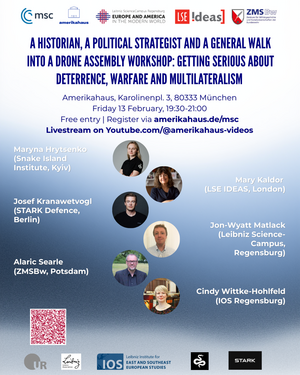
The Leibniz-ScienceCampus Europe and America, LSE IDEAS and the Bundeswehr Center of Military History and Social Sciences (ZMSBw, Potsdam) are delighted to be organizing a side event as part of the Munich Security programme at Amerikahaus in Munich. You are warmly invited to a panel discussion on Friday 13 February at 19:30 on the subject of Deterrence, Warfare and Multilateralism. The discussion will be chaired by Cindy Wittke-Hohlfeld (IOS) with Maryna Hrytsenko (Snake Island Institute), Mary Kaldor (LSE), Josef Kranawetvogl (STARK), Jon-Wyatt Matlack (ScienceCampus / LSE), and Alaric Searle (ZMSBw) on the panel.
You can re-watch the discussion via the Amerikahaus Youtube channel here.
The side event was hosted by Amerikahaus as part of its Emerging Leaders series of MSC Side Events. The full programme of MSC@Amerikahaus events can be found here.
A Historian, a Political Strategist and a General Walk into a Drone Assembly Workshop.Getting Serious about Deterrence, Warfare and Multilateralism
Outline | Unmanned systems and drone warfare – most prominently in Russia’s war against Ukraine – are unsettling the post-Cold War security order. In the complex emerging ecology of warfare, deterrence and new technologies, unmanned systems increasingly weaponize and target civilian and military infrastructures: satellites, energy supply, communications networks. Transformative, low-cost drone warfare technologies undermine established defence systems while redefining power and military violence, as well as resilience and preparedness.
Prompted by evolving conflicts and emerging technologies, this session reappraises deterrence, multilateralism and the transatlantic order. Senior armed forces figures, policy advisors, academic theorists and defence-tech experts – voices rarely in dialogue – examine: How quickly can NATO adapt to shifting technological and political ecosystems? Are unmanned systems the key to Europe’s security? What visions for new European security arrangements could emerge – with or without the USA? And what lessons from Ukraine can guide strategic planning in an increasingly multipolar world?
Speakers & Chair

Maryna Hrytsenko is co-founder and executive director of the Kyiv-based Snake Island Institute, which works on ensuring the lessons, innovations and institutional shifts forged in Ukraine on the battlefield, in defence technologies and in diplomatic endeavours become part of the broader security architecture of NATO, the United States and other democratic allies. Maryna leads the Institute’s efforts to strengthen long-term U.S.–Ukraine defense cooperation through policy, advocacy, and strategic outreach. She previously served as a foreign policy advisor in Ukraine’s Parliament and held senior roles in international events and communications. She graduated from Vassar College (NY, USA) and studied at Benton High School, Louisiana in 2018 as U.S. Department of State exchange scholar. Photo: Snake Island

Mary Kaldor is Professor Emeritus of Global Governance and Director of the Conflict Research Programme, LSE IDEAS at The London School of Economics and Political Science. She previously worked at the Stockholm Peace Research Institute and the University of Sussex, including the Science Policy Research Unit, before coming to the London School of Economics in 1999. In addition, she was a founder member of European Nuclear Disarmament (END), founder and Co-Chair on the Helsinki Citizen’s Assembly, a member of the Independent International Commission to Investigate the Kosovo Crisis. She has pioneered the concepts of new wars and global civil society. Her elaboration of the real-world implementation of human security has directly influenced European and national governments. She is the author of many books and articles including New and Old Wars: Organised Violence in a Global Era (3rd edition, 2012), International Law and New Wars (with Christine Chinkin, 2017) and Global Security Cultures (2018). Photo: LSE

Jon-Wyatt Matlack recently submitted a doctoral dissertation on U.S. Army-Bundeswehr joint War Games as Conduit for Western Identity Formation at the University of Regensburg, with funding from the Leibniz ScienceCampus Europe and America. Jon earned his Bachelor‘s degree at Syracuse University in 2015 with a triple major in History, International Relations, and German Language followed by a Master’s in European-American Studies in Regensburg. Previously he was a visiting fellow at LSE Ideas as an Anthony D. Smith Fellow, and also at the Center for Military History of the German Armed Forces (ZMSBw). Jack studies the intersection of strategic communication, military training, and operational doctrine on the one hand, and nationalism and identity on the other. He is co-editor with Elia Bescotti of Sovereignty through Practice (Routledge, 2025) and co-author with Sebastian Schwartz and Oliver Gill of the LSE Research Report Ukraine's Drone Ecosystem and the Defence of Europe: Lessons Lost Can't be Learned. He also works in strategy consulting. Photo: Private

Josef Kranawetvogl is a Senior Vice President at STARK, a European defence-tech company developing unmanned systems in close cooperation with Ukraine. Before joining STARK, Josef was responsible for space security policy at the German Ministry of Defense and civil-military cooperation in the space domain between the German Armed Forces Space Command and the German Space Agency. He joined the German Armed Forces in 2006, and holds a Master of Science in Aerospace Engineering and a Master of Arts in Military Leadership and International Security. He was a graduate of the 20th National General Staff/Admiral Staff Course at the German Armed Forces Command and Staff College. Foto: STARK

Alaric Searle has been Senior Researcher and Head of Research at the ZMSBw Centre for Military History and Social Sciences of the German Armed Forces since 17 July 2023. He is also honorary professor at the University of Potstam. In His role at ZMSBw, he is responsible for the scientific orientation and research projects of the ZMSBw Centre for Military History and Social Sciences of the German Armed Forces and its historical, social science and increasingly interdisciplinary research. This also includes joint editorship with the Commander of the ZMSBw Centre for Military History and Social Sciences of the German Armed Forces of the Militärgeschichtliche Zeitschrift, the scientific, biannual journal of the ZMSBw Centre for Military History and Social Sciences of the German Armed Forces. In addition to his diverse and wide-ranging coordination and management tasks as a senior researcher, Alaric Searle also conducts his own research that has addressed the intersections of theory, doctrine, warfare and technological innovation. Foto: Bundeswehr / Andrea Nimpsch
 Cindy Wittke-Hohlfeld is Head of the Department of Politics at the Leibniz Institute for East and Southeast European Studies (IOS) in Regensburg and Professor for Normativity in International Politics at the University of Regensburg. She is Deputy Speaker of the Bavarian Alliance for Peace, Conflict and Security Research (FoKS) and Principal Investigator of the Leibniz ScienceCampus Europe and America in a Modern World. Her research focuses on international law and politics, peace and conflict studies, and Eastern Europe, with particular attention to unresolved territorial conflicts, peace negotiations, post-war orders, and the politics of international law. Her publications include Law in the Twilight (Cambridge University Press, 2018) and, with Mandy Ganske-Zapf, Frieden verhandeln im Krieg (Negotiating Peace in War, Bastei Lübbe/Quadriga, 2024). Photo: IOS/Neverflash