
Law & Borders
Research Network
About the Network
 Drawing on our backgrounds in law and border studies, our project begins with the observation that law does not only draw borders on paper. It shapes and regulates them, creating thresholds that complicate the lives of those who cross or live alongside them. Borders, in this sense, are not static lines but shifting legal constructs that affect who may move, under what conditions, and with what consequences.
The Law & Borders Network Concept Paper by the speakers Dr. Marie Beyrich and Dr. Mélanie Sadozai is published in a tab below.
The Research Network is part of the Leibniz ScienceCampus' efforts to support innovative, multidisciplinary early career research.
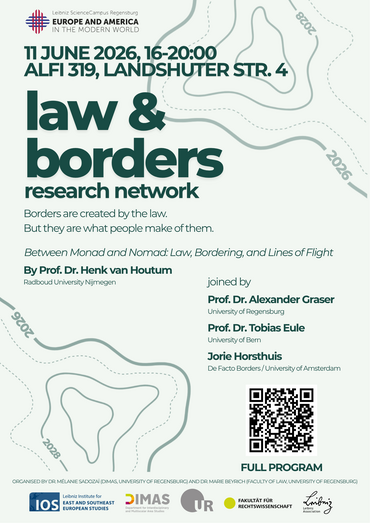
Find out more about the network at the opening event on Thursday, 11 June 2026 from 16:00-20:00 in Room 319 at the Altes Finanzamt / IOS, Landshuter Str. 4, in Regensburg. Click the activities tab below for the programme or download the poster or programme flyer here.
The opening event is co-financed by the UR Law Faculty and the Equal Opportunities Office.
Law & Borders
Launching an Early Career Researcher Network
By Dr. Marie Beyrich & Dr. Mélanie Sadozaï
Why We Begin with Law
Drawing on our backgrounds in law and border studies, our project begins with the observation that law does not only draw borders on paper. It shapes and regulates them, creating thresholds that complicate the lives of those who cross or live alongside them.
Borders, in this sense, are not static lines but shifting legal constructs that affect who may move, under what conditions, and with what consequences. They are also felt in everyday realities – in access to welfare or the labour market, in visa rules enforced at airports or embassies, or in the quiet persistence of “bordering” or “rebordering” in contested regions.
From Lines on Paper to Everyday Realities
Traditionally, borders have been understood as political markers. However, critical border scholars have challenged this approach, drawing attention to borders’ lived dimensions. Nevertheless, this scholarship has only partially explored how legal frameworks set the conditions for who may cross, under which circumstances, and with what rights.
In our work, we take law as the starting point of everyday life. Borders matter for people: they take shape in regular encounters, in access to work or welfare, and in local memories of past divisions.
Geography, politics, and culture continue to play a crucial role, but law now often provides the decisive framework through which these other factors are channelled and made tangible.
Our Approach: Border Labs
To study these dynamics, we are establishing an international early career research network, funded through the Leibniz ScienceCampus Europe and America in the Modern World.
Our core method is the Border Lab. This involves immersive, field-based encounters in regions where law, politics, and everyday life collide in distinctive ways.
Focus Areas
Bavarian / Bohemian Border
From Iron Curtain to Schengen
This border illustrates the transition from alienation constructed by militarised closure to an integrated cross-border space – albeit one that remains vulnerable to disruption and processes of rebordering, for instance during pandemics or due to political contingencies.
The Channel Islands
As Crown Dependencies between the UK and France, the Channel Islands highlight legal entanglements in maritime boundaries, fishing rights, and immigration.
Georgia – Abkhazia
This contested de facto border shows how legal claims, international recognition, and lived realities interact under conditions of “borderization”.
The project deliberately addresses diverse sites. Each allows us to explore how borders are constituted in practice, and how law both structures and unsettles them.
Interdisciplinary and Collaborative
The network brings together doctoral and postdoctoral researchers from Germany, France, the UK, and Belgium.
Beyond legal analysis, we combine methods and perspectives from:
- Political science
- Geography
- History
Critical border studies, ethnographic fieldwork, and discourse analysis enrich our starting point in law, ensuring that borders are not only studied as legal abstractions but also as lived spaces, narrated experiences, and visualised realities.
This interdisciplinary mix allows us to capture how legal frameworks interact with historical, political, social, and economic forces in shaping the meaning and practice of borders.
Outputs and Trajectories
The project will unfold between 2026 and 2028 with:
- Opening and closing events in Regensburg to frame and present our work
- Three Border Labs across Europe and the Caucasus
- A public exhibition translating findings into accessible visual formats
- A special journal issue to anchor the research academically
Longer term, we plan to establish a Border Lab at the University of Regensburg as a permanent hub for interdisciplinary border research and teaching.
Looking Ahead
The Law and Borders Network is both a research agenda and a collaborative experiment.
By grounding legal analysis in interdisciplinary dialogue and fieldwork, we hope to capture the evolving, uneven, and deeply human realities of borders.
Our presentation in Exeter was only the starting point. Over the coming years, through our network and Border Labs, we aim to continue these conversations:
- Across disciplines
- Across borders
- With communities for whom borders are not abstract lines, but lived realities
Contact
If you are interested in our work, would like to get involved in the network, or have contacts, suggestions, or knowledge that could enrich our project, we would be delighted to hear from you:
| Name | Affiliation | Expertise |
| Network Speakers | ||
| Dr Marie Beyrich | UR, Law Faculty | Postdoctoral Researcher in Public and European Law at the University of Regensburg. Her current research focuses on democratic pluralism and the legal regulation of transnational influence, exploring how democracies respond to external influence on their internal democratic processes and under what conditions such regulation remains compatible with democratic self-government. Her work combines doctrinal analysis with comparative and empirical methods. In the field of migration law, she has focused in particular on family reunification, adopting a socio-legal perspective to analyse how legal frameworks structure access, belonging, and participation in practice.
|
| Dr Mélanie Sadozaï | UR, DIMAS | Postdoctoral researcher at the Department for Interdisciplinary and Multiscalar Area Studies (DIMAS) at the University of Regensburg. Her research explores the multiple forms of cross-border relations in the borderlands of the Pamir Mountains, where she has conducted consistent ethnographic fieldwork for over a decade. Her current research investigates cross-border relations under disrupted political conditions, with a focus on exchanges between Central Asia and Afghanistan under Taliban rule. |
| Members | ||
| Dr Ariane Bachelet | University Paris 1, France | An associated Researcher at the Research Centre for the Organisation and Dissemination of Geographical Information (PRODIG) in Paris. She holds a PhD in Political Geography from the University of Panthéon-Sorbonne. For more than seven years, she studied border issues in the specific cases of Abkhazia and South Ossetia, two disputed political entities located in the South Caucasus between Georgia (de jure sovereignty) and Russia (providing military protection, among other things).
|
| Karst Berkenbosch | University of Leuven, Belgium | A PhD researcher at the KU Leuven with a strong interest in how geopolitics are shaped in everyday settings. That includes a focus on how interacting top-down and bottom-up processes shape borders, territories and cross-border relations, as well as how human-environment interactions add into this mix. He currently researches how cross-border relations in the Gulf of Saint-Malo, a cross-border marine region between the Channel Islands, the UK and France, are shaped by people working in and governing the local fishing industry.
|
| Felix Bruckner | UR, Zentrum Erinnerungskultur (ZE) | A Cultural Studies scholar interested in the intersection of Border and Memory Studies. For his master’s thesis, he examined the narratives of the Bavarian-Bohemian border (region) in regional museums. Currently, he works as a research associate and coordinator of the participatory digital exhibition project “Grenze neu gedacht / Hranice jinak” (Border rethought) at the Flossenbürg Concentration Camp Memorial in cooperation with the Center for Commemorative Culture of the University of Regensburg.
|
Queen Mary University, London, UK | A third-year PhD researcher at Queen Mary University of London. Her research explores how law shapes the protection of people displaced by climate change, with a particular focus on Northern Central American communities. Through socio-legal analysis and qualitative fieldwork in the region, she investigates the gap between legal frameworks and the lived realities of displacement.
| |
| Radboud University, Netherlands | A PhD Researcher in Political Geography at the Nijmegen Centre for Border Research (NCBR), Radboud University. Her research focuses on the EU external Bordering Regime and Asylum Policy in Southernmost EU Borderlands (particularly in Greece and Cyprus). Also, through the 'Constructing the Limes' project (C-Limes), she revisits and reconstructs the Roman legacy, conceptual and mythical imaginaries and narratives in dominant geopolitical discourses on borders and migration.
| |
| Maynooth University, Ireland | A postdoctoral researcher on the IRC funded project, 'CONSPACE: Penal Nationalism and the Northern Ireland Border', led by Dr. Lynsey Black. Her research within the project explores how the border on the island of Ireland is enforced, focusing on the impact of bordering practices on migrants, including asylum seekers, and refugees.
| |
| Luuk Winkelmolen | Radboud University, Netherlands | A PhD Researcher in Political Geography at the Nijmegen Centre for Border Research (NCBR), Radboud University. His research focuses on the construction and mobilisation of selective chronopolitical narratives to popularise and legitimise contemporary b/ordering and othering policies and practices. As part of the ‘Constructing the Limes’ project (C-Limes), he researches and deconstructs how selective readings of the Roman geohistorical legacy and interpretation are mobilised and weaponised in contemporary geopolitical discourses on borders, territories, and migration.
|
Upcoming Events
The Opening of the Research Network
Thursday, 11 June from 16:00-20:00 in Room 319 at IOS, Landshuter Str. 4, Regensburg. All are welcome to attend.
- download the poster or programme flyer
Schedule:
 16:15 – 16:30
Introductory Remarks by the Network Speakers: Dr. Mélanie Sadozaï and Dr. Marie Beyrich
16:30 – 17:15
Keynote talk
Between Monad and Nomad: Law, Bordering, and Lines of Flight by Prof. Dr. Henk van Houtum (Radboud University, Nijmegen)
17:30 – 17:45
“Watch the Border”: Visual Quiz and Instinctive Takes on Border Questions from the Audience
Presented by Jorie Horsthuis & Dr. Mélanie Sadozaï
17:45 – 18:45
Expert Panel
What do Law and Border Studies Have to Say?
Featuring Prof. Dr. Tobias Eule (Bern), Prof. Dr. Henk van Houtum (Nijmegen), Jorie Horsthuis (Amsterdam)
Chaired by Prof. Dr. Alexander Graser (UR)
19:00 – 19:30
Everyday Border Experiences: Students and Audience in Conversation with our Experts
Chaired by Dr. Mélanie Sadozaï
19:30 – 19:45
Closing Input: How do we Report on Borders?
By Jorie Horsthuis
19:45 – 20:00
Final Remarks
Dr. Mélanie Sadozaï and Dr. Marie Beyrich
The Co-Speakers
For enquiries about the research network's activities, please contact the speakers via their UR addresses.
For general enquiries about the Leibniz ScienceCampus please write to campus@europeamerica.de.